
When Something Sacred Becomes Something Else
A reflection on cacao, ceremony, and what happens when the center begins to shift

I didn’t expect to write this.
It comes from a feeling I’ve been sitting with for some time now, and after our tasting together on Saturday, something clicked into place.
I wrote it for myself, but I wanted to share it with you here.
I’ve been noticing something over the past few weeks, a feeling I couldn’t quite name.
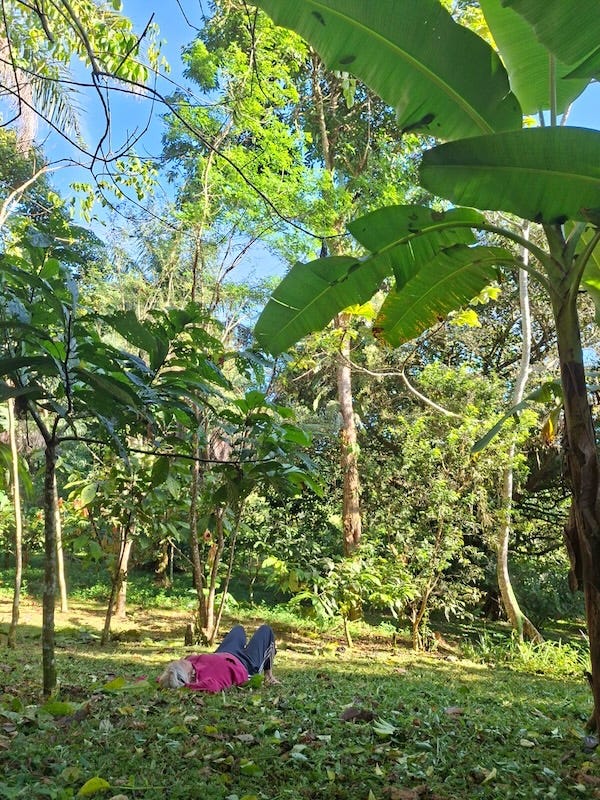
Earlier this week I took my blanket out under the cacao trees for an afternoon break. In the shade of mama cacao, I began to stretch, moving into downward dog and letting go of the tension that had been building from standing in one place all morning.
There was no plan for it. Just a few movements, a few breaths, and the feeling of my body coming back to itself.
And in that moment, it became clear.
Cacao ceremonies are beginning to remind me of Yoga, especially as “ceremonial cacao” has become more common in the world of wellness.
Not the kind of yoga that happens at home, early in the morning before the day begins, when a woman rolls out her mat and moves in her own rhythm. I’m thinking of the other kind, the one that filled studios, took on structure, schedules, and eventually became something you could recognize from the outside.
There is nothing inherently wrong with that shift. It has opened the door for many people. But it is a different experience than what came before.
I say this as someone who works with cacao every day, not as an observer standing outside of it.
When I make cacao, I sometimes choose to do so on the full moon, the new moon, or at the turning points of the year like the solstice or equinox. I don’t do this to make a claim about the cacao or to suggest it becomes something else. It is a way of entering the work.
On those days, I feel a deeper connection to what is around me. The sky, the moon, the sun, the stars, and most of all the earth itself. Pachamama is the ground I walk on, the place where this cacao grew, and the source of everything that makes this work possible.
I believe in cycles. I see them on the farm every day, in the trees, in the harvest, in what is ready and what is not. When I choose to make cacao at these moments, I am stepping into that rhythm more consciously.
I am in deliberate ceremony with the plant.
That is what ceremonial cacao means to me.
Not a claim about what the cacao will do for you.
Not a promise of transformation.
But a way of working that keeps me in relationship with the land, with the timing, and with the quiet responsibility of what I am making.
Because cacao does not begin with us.
It begins on the land. I walk those trees. I harvest the pods, open them, and tend the cacao through fermentation and drying over the course of weeks. Those stages shape everything, the flavor, the structure, and the life of the cacao.
By the time it reaches the kitchen, it already carries the imprint of the land, the weather, the timing, and the care it received along the way.
What happens afterward is part of that continuum.
The word “ceremonial” has become very large in recent years, and I find it is often used to point to different things at once. Sometimes it refers to the cacao itself, sometimes to the way it is consumed, and sometimes to the experience built around it. When those meanings blend together, it becomes harder to see clearly what we are actually engaging with.
There is another layer to this that feels important to name, because it changes the experience in a quiet but significant way.
In some spaces, the center begins to shift away from the cacao and toward the person holding the room. The language expands, the experience becomes more structured, and there is a subtle sense that something will be given to you if you are in the right place with the right guide.
I find myself pausing there, not because anything is necessarily wrong, but because the balance feels different.
Ceremony, as I understand it, does not come from a single person. It is not something that can be created and delivered to you. It is something you enter into through your own relationship with the plant, with the land, and with yourself.
When that relationship is intact, it does not need to promise outcomes or position itself around a central figure.
So when the experience becomes organized around one voice or one source of authority, it can begin to feel less like an authentic ceremony and more like something shaped into a performance from the outside.
I am not interested in guiding anyone in that way.
I am interested in growing cacao well, working with it carefully, and offering it cleanly.
What happens when you sit with it belongs to you.
Here on the farm, ceremony looks different.
It happens under the cacao trees, often with a small group or sometimes one on one. There is space to sit, to taste, to speak if you want to, or to remain quiet if you don’t. No one is watching you, and no one is guiding you toward an outcome.
There is time for the cacao to open slowly, and for you to notice what is actually there, without needing to arrive anywhere.
The cacao is there. The land is there. You are there.
That is enough.
Some of the spaces I see now feel quite full. There is a lot happening in them, a strong shared energy, sound, movement, and a sense of being part of something collective.
I understand why that draws people in. There is comfort in belonging, and there can be real connection in those environments. But I also notice that it is not where I feel most at home.
What continues to hold me is something more direct.
A cup of cacao, or a piece of chocolate, taken without distraction. A moment that does not ask me to respond to anything or perform anything, where I can simply pay attention to what is in front of me.
The way it melts across the tongue. The way the aroma rises before the first sip. The warmth of it in your hands before you drink. These are small things, but they are not insignificant.
So the question that stays with me is a quiet one.
When something that begins as a grounded practice becomes widely shared, what remains intact, and what begins to shift?
We have already seen this happen with yoga, where a deeply rooted practice was, in many places, reshaped into something more visible, more commercial, and at times more removed from its origins. Some spaces have held onto its depth. Others have moved further away from it.
Cacao is at a similar threshold.
If you have chocolate in your kitchen, or a block of cacao, you might try something simple tonight.
Make yourself a cup of warm drinking chocolate. Sip it without rushing. Notice what you taste, how it changes your mood, your body, and your energy. Notice how long it lingers.
Then ask yourself, quietly,
is this enough?
Or are you looking for something more to be added to it?
If you’d like to experience cacao this way, you can join me here on the farm in a small gathering under the cacao trees, or begin at home with what you already have.
And if this is something you’ve been noticing too, you can write back and tell me what you’re seeing.”
x, Lyn
Lyn Bishop grows certified organic cacao at Finca Las Heliconias in Chiriquí Province, Panama, where she founded Quetzal Cacao, a tree-to-bar chocolate brand.